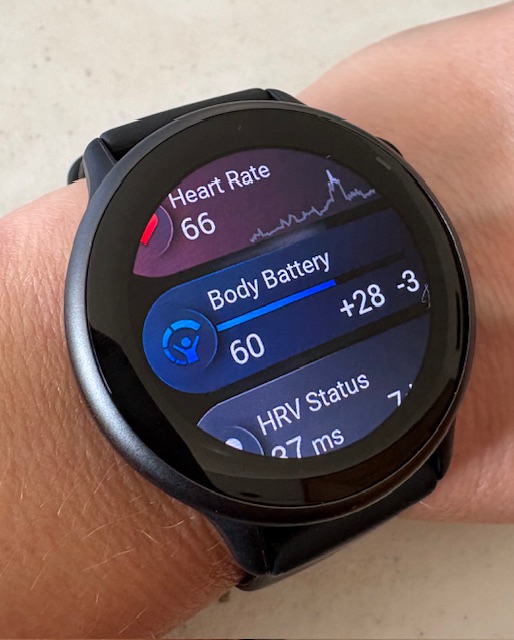
• After a long time thinking about it, I recently got a Garmin Vivoactive 6.

    It’s a health and fitness GPS smartwatch. I love it. Though I don’t know how to completely use it yet.

    The watch has a touchscreen and a couple of manual push buttons. I’m still stumbling around navigating them at this point.

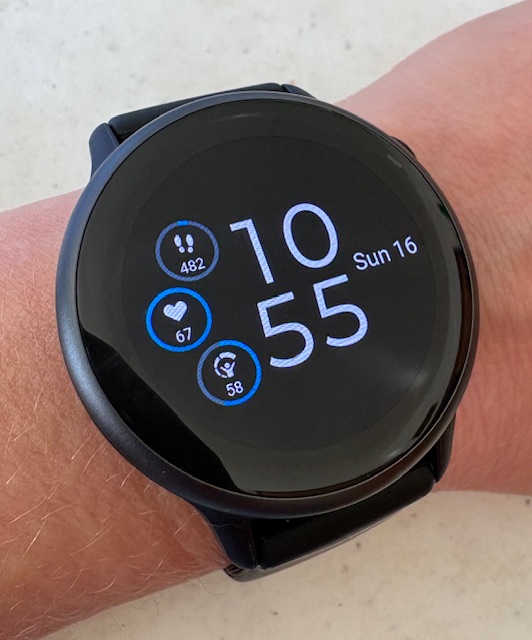
    I have been able to set a watch face that I like. I’m able to see my step count by scrolling up on the touchscreen. I’ve recharged my phone at least once – fabulous battery life btw: 11 days on a single charge. I’ve also downloaded the Garmin Connect app on my phone, though it’s still fairly undecipherable to me at the moment.

    So maybe it’s time to start digging into this thing one feature at a time.
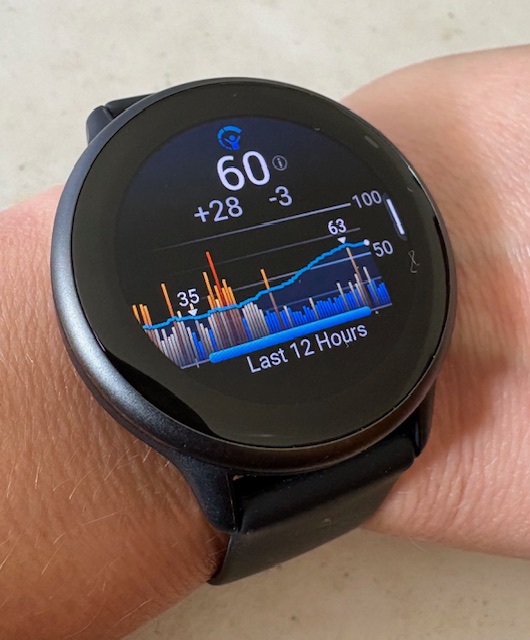
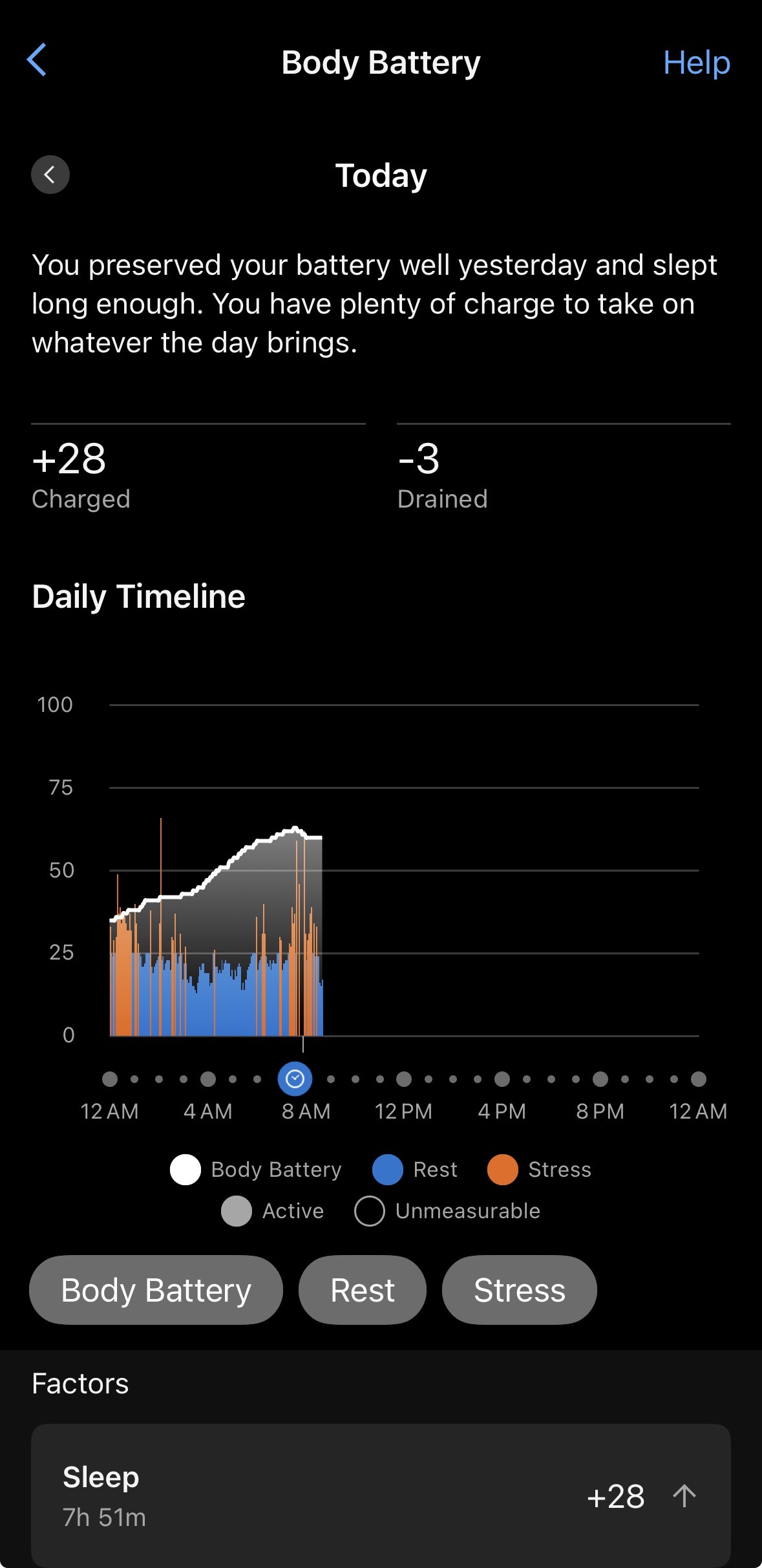
    One icon and feature I keep seeing is the Body Battery measurement. This seems like its trying to tell me something interesting, but what? It gives me a score and it has a chart showing bars representing ‘Rest’ and ‘Stress.’ The overarching line crests up and troughs.

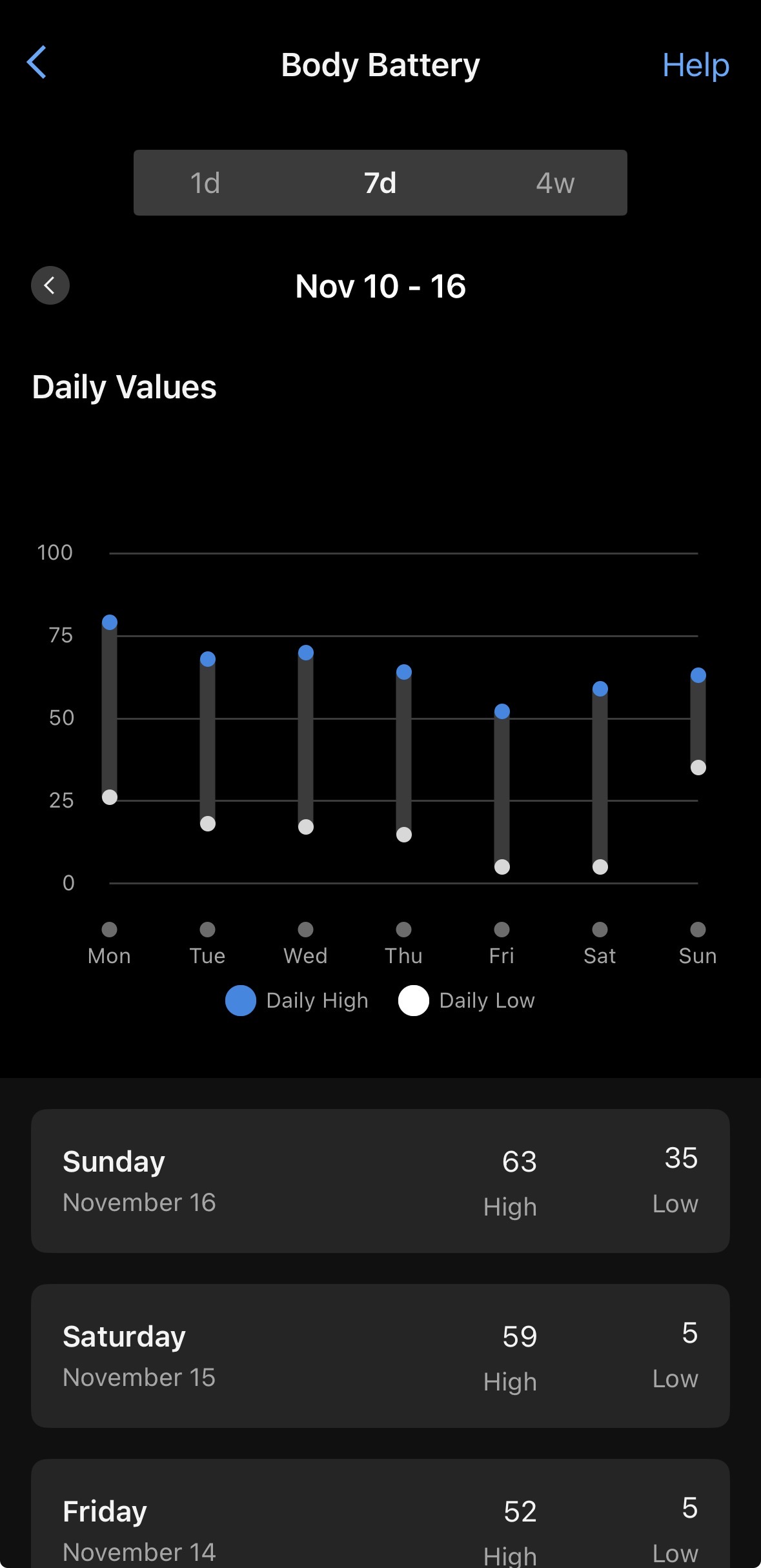
    The Connect app shows my 7 day energy ranges. Am I supposed to try to make it to 100?
    And what is this measuring exactly? According to the Garmin website: “The Body Battery feature works by continuously analyzing combinations of heart rate, heart rate variability (HRV) and movement data while you wear your device.”

    Garmin’s website also appears to lay out how they evaluate my nervous system state: parasympathetic vs. sympathetic. (The stress level numbers are different than the body battery measurements.)
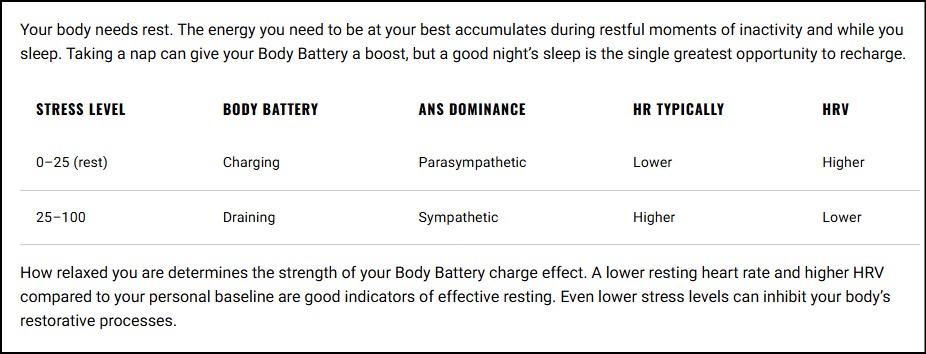
    Garmin BODY BATTERY™ ENERGY MONITORING, website screenshot
    Source: https://www.garmin.com/en-US/garmin-technology/health-science/body-battery/

    It tells me sleep is powerful for restoring the body. This, well, this does make sense. I will continue to keep an eye on my 7 day chart to see what appears to be having the most impact.


  • … a lot of people are talking about it because they realize it’s not their fault. It’s not that their kid’s an idiot … it’s just so much bigger than the individual kids. -WSJ

    The economy is changing. Young adults are facing a harrowing set of challenges that many are seeing for the first time, as are their parents.

    Some young folks are able to rely on financially-stabilized families. And what for those without?

    Today’s job search is different. The job market is different. There are new sets of obstacles: tariffs putting the brakes on hiring, AI picking off entry-level roles. I hardly feel like mentioning the albatross of healthcare costs and home prices.

    I believe my grandparents rented just a single bedroom in a home when they first married. Are we asking young adults to bear a natural coming-of-age shock, or is this something altogether different?

    Will these circumstances compel new, hard, and practical adaptations? I feel unnerved thinking that some of the least supported could find themselves in places of real vulnerability.

    In all the contortions of one young person’s job hunt, she was asked to write an obit for herself at a networking event – to help channel focus. Personally, I have never found this thought process to be wholly resonant. (I think my cat could write a fair eulogy for me to be honest.)

    The following WSJ article has 1,490 comments. I think I will spend time browsing them to get some more boots on the ground thoughts …

    The Economy That’s Great for Parents, Lousy for Their Grown-Up Kids
    https://www.wsj.com/personal-finance/old-young-economic-divide-7a5203f0

    Plus more details from a CNBC article:

    • Postings for entry-level jobs in the U.S. sank 35% since 2023
    • Some industries are more prone to disruption, such as tech and finance
    • Others are more insulated for now, including nursing and blue-collar jobs

    ‘AI puts the squeeze on new grads — and the colleges that promised to make them employable’
    https://www.cnbc.com/2025/11/15/ai-puts-the-squeeze-on-new-grads-looking-for-work.html

  • More Zzz’s please

    As it turns out, sleep may make us more civil.

    I’ve happened across an interesting paper: “Sleep loss leads to the withdrawal of human helping across individuals, groups, and large-scale societies.”

    The researchers note that acute stress, including cortisol release, may play a role in reducing prosocial behavior while increasing egoistic choices in moral dilemmas.

    This paper is from 2022, so I will look into it more and continue to add anything else I find in the coming days…

    Photo by Justine Camacho on Unsplash

    “The implications of this effect may be non-trivial when considering the essentiality of human helping in the maintenance of cooperative, civil society … “

    More at:

    https://journals.plos.org/plosbiology/article?id=10.1371/journal.pbio.3001733

    https://reasons.org/explore/blogs/todays-new-reason-to-believe/sleep-loss-leads-to-altruism-decline

    https://www.humansleepscience.com/p-u-b-l-i-c-a-t-i-o-n-s

  • Are all your contributions making it into your plan?

    Losing money is a sickening feeling. Especially money you’ve earned, and are legally entitled to.

    One employee lost $100,000 from her former employer: $50,000 from missing 401(k) contributions and earnings and much the rest from unpaid wages.

    In February, the company president had urged Otter to stay. The company dissolved on March 6.

    Small companies, like her former employer, are often the most vulnerable to missing funds.

    Legal requirements are in place. Sometimes money is recovered. Sometimes it’s not.

    $100,000.

    Are you regularly checking to make sure the 401(k) contributions that are deducted from your paycheck are making it into you retirement account?

    It’s a good reminder for all of us: setup a system to check.

    WSJ post on X, October 19, 2025
    photo of employee, link to article
    ‘A nest with sticks falling out’
    AI generated image using Google Nano Banana

    More at:

    ‘Her 401(k) Contributions Vanished—and Her Company Had No Answers’
    https://www.wsj.com/personal-finance/retirement/her-401-k-contributions-vanishedand-her-company-had-no-answers-1bc95d27

    401(k) Garmin Health Personal finance Sleep Smartwatch WSJ