What does it mean to do chores mindfully?
Feeling the warmth of the water on your hands while washing the dishes, the weight of them. Not rushing through to something better. More like a bird building their nest. Part of the art. Part of the song.
What does it mean to do chores mindfully?
Feeling the warmth of the water on your hands while washing the dishes, the weight of them. Not rushing through to something better. More like a bird building their nest. Part of the art. Part of the song.
‘Calm with Kyle’ shares an interesting technique to practice turning down anxiety.
From the paper:
The processing of positive memories technique (PPMT) is a promising new adjunctive treatment approach for PTSD that involves the detailed narration and processing of specific positive memories (Contractor et al., 2021). PPMT is based on the positive memory PTSD model, which integrates findings from experimental research, memory-based interventions, and positive psychology intervention research. This model outlines that retrieving salient and specific positive memories helps trauma survivors (a) improve affect, cognitions, and the ability to retrieve more positive memories; (b) engage in behavioral activities aligned with their values and strengths; and (c) replace traumatic memories as a point of reference to view themselves, others, and the world. Such processes ultimately help to decrease PTSD symptoms (Contractor et al., 2018, 2022)
From the WSJ:
The fundamental problem is that federal law created an incentive structure that makes psychiatric medication the default for tens of millions of Americans who might be better served by therapy, lifestyle intervention or no clinical intervention at all.
The rise in diagnoses and the “prescription cascade” used to treat symptoms resultant from prior medications seems formulaic but lazy. I’m glad to see more incentives that support moves away from over-medication. It would be nice to see more measures of well being and resilience researched and incentivized.
From the NYTimes:
Under one classification widely used among the scientific community, essentially any foods or drinks made with ingredients you wouldn’t find in a home kitchen are defined as ultraprocessed. If regulators adopt that sort of definition, nearly three-quarters of foods sold in the United States could be deemed ultraprocessed.
[…]
Many scientists support a strong definition, and noted that evidence linking ultraprocessed foods to a host of chronic diseases, including obesity, Type 2 diabetes, heart disease and some types of cancer, has grown in the last decade.
From the WSJ:
Scientists don’t yet understand who will benefit from a particular antidepressant, or any antidepressant at all, beyond a placebo effect of taking a pill. Only 15% of people with major depression experienced a substantial benefit from taking antidepressants beyond the placebo effect, according to a 2022 study.
HHS will encourage doctors to consider lifestyle changes, over drugs, for depression.
Posttraumatic stress disorder (PTSD) is a mental health condition with widespread effects on mental and physical health and mortality. In this paper, we present the current state of research on the epidemiology of PTSD, including its prevalence, risk factors, and impact. The U.S. lifetime prevalence of PTSD is estimated to be 6.1%–8.3%, and the global prevalence is estimated at 3.9%. PTSD prevalence has been consistently found to be higher among certain subgroups, including women and military veterans. Risk factors for PTSD include pretrauma variables, preexisting mental health conditions, sociodemographic characteristics, and features of the traumatic event itself. Consequences of PTSD include effects on psychiatric comorbidity, physical health conditions, and all-cause and cause-specific mortality. Points of consideration and challenges affecting the study of PTSD epidemiology are noted, including debates on specifying a trauma criterion for diagnosis, the validity of complex PTSD as a diagnosis, and the dearth of recent population-based longitudinal data to understand this disorder. Suggestions for future research and clinical implications are discussed.
An excellent award-winning documentary examining the harms of over- and mis-prescribing psychiatric medications for ‘normal’ human suffering.
After a long time thinking about it, I recently got a Garmin Vivoactive 6.
It’s a health and fitness GPS smartwatch. I love it. Though I don’t know how to completely use it yet. (Owner’s manual).
The watch has a touchscreen and a couple of manual push buttons. I’m still stumbling around navigating them at this point.
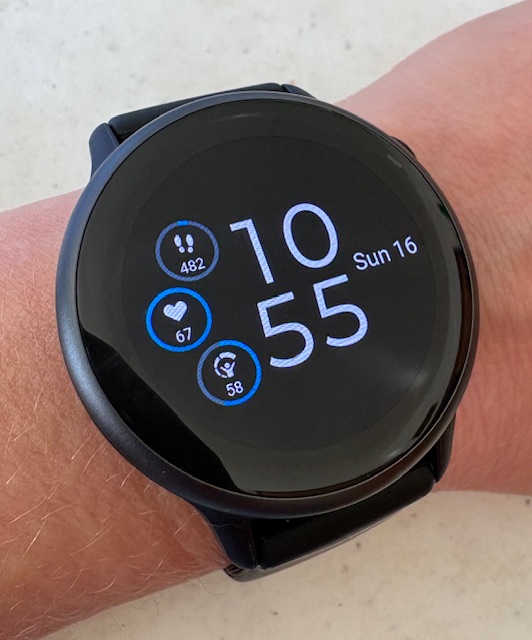
I have been able to set a watch face that I like. I’m able to see my step count by scrolling up on the touchscreen. I’ve recharged my phone at least once – fabulous battery life btw: 11 days on a single charge. I’ve also downloaded the Garmin Connect app on my phone, though it’s still fairly undecipherable to me at the moment.
So maybe it’s time to start digging into this thing one feature at a time.
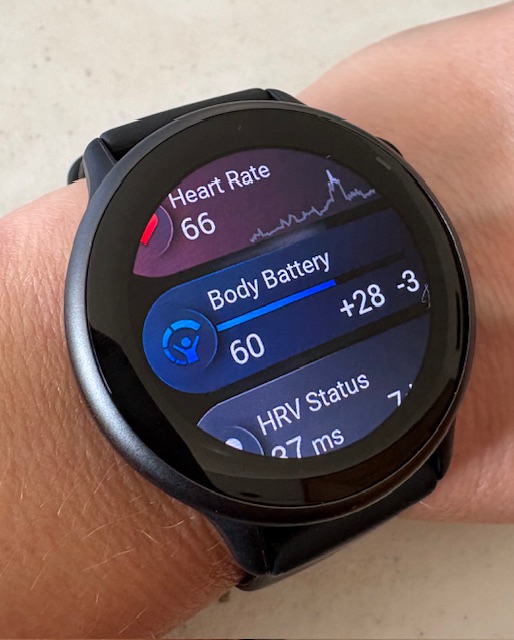
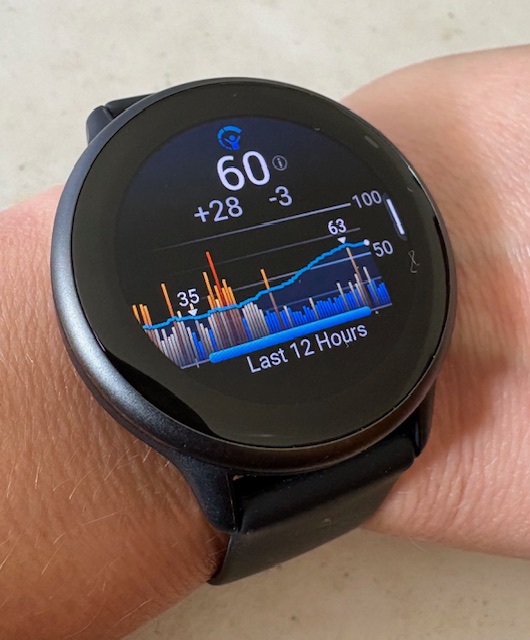
One feature I keep seeing is the Body Battery measurement. This seems like its trying to tell me something interesting, but what? It gives me a score and it has a chart showing bars representing ‘Rest’ and ‘Stress.’ The overarching line crests up and troughs.
The Connect app shows my 7 day energy ranges. Am I supposed to try to make it to 100?
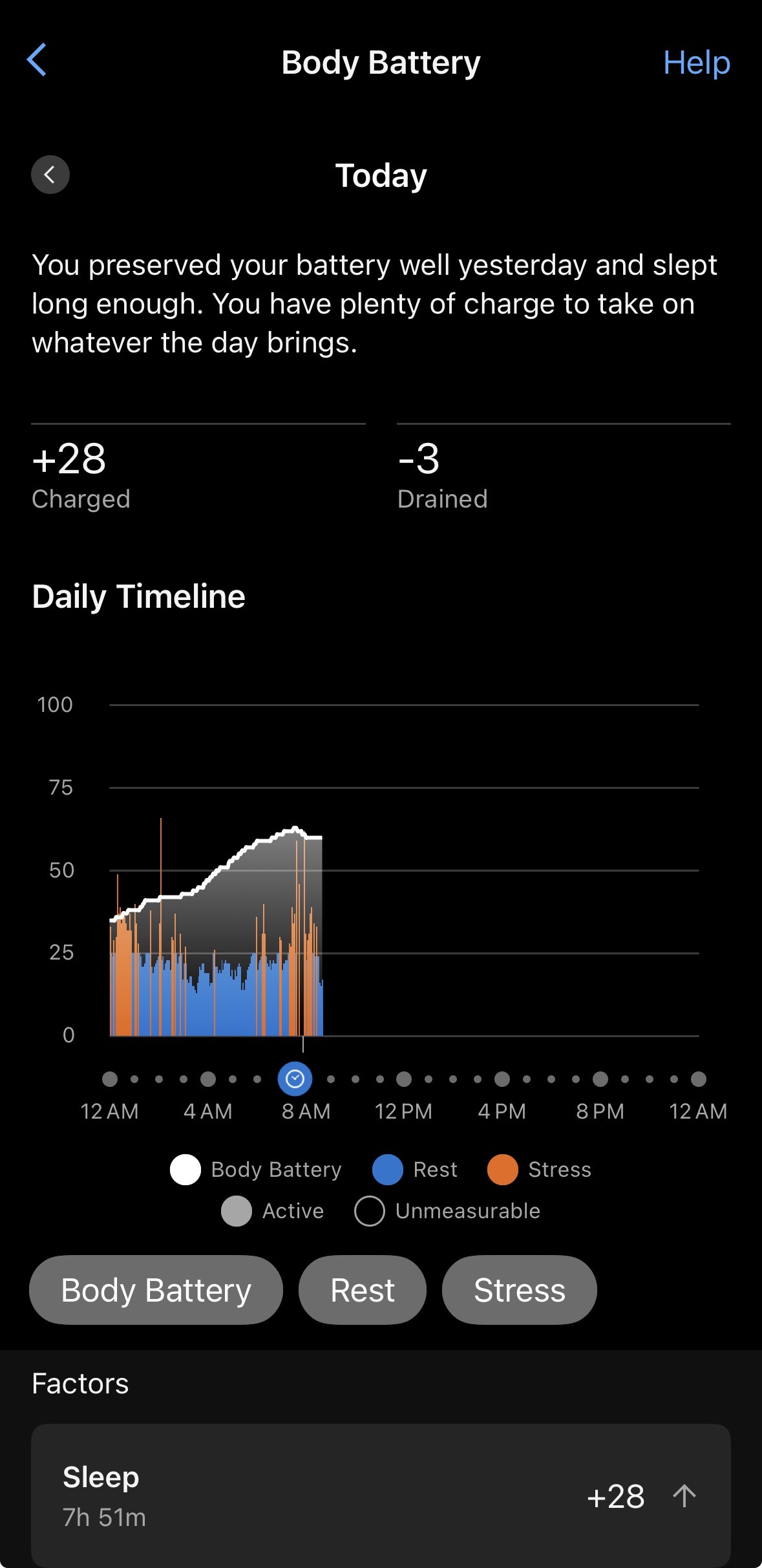
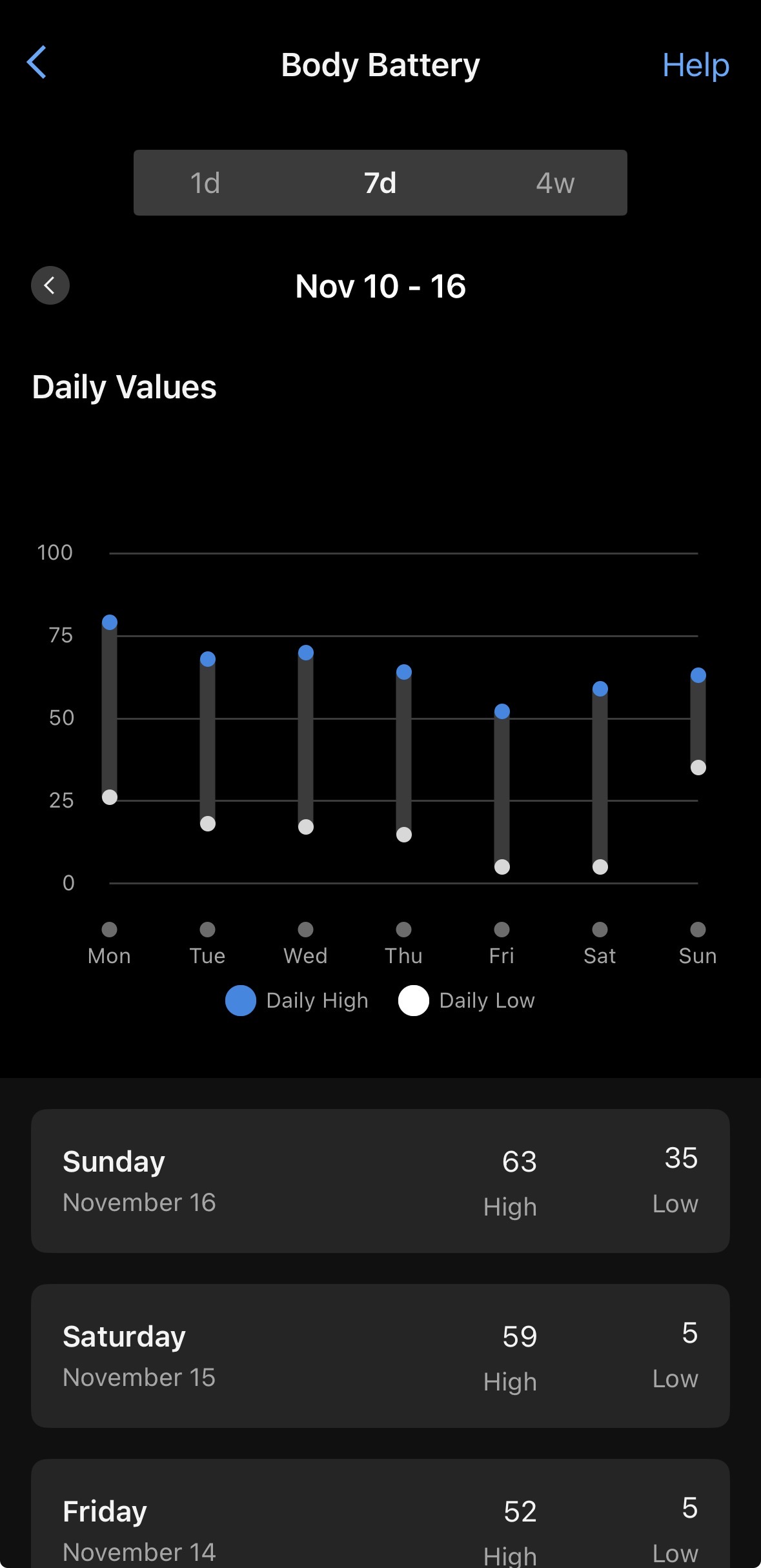
And what is this measuring exactly? According to the Garmin website: “The Body Battery feature works by continuously analyzing combinations of heart rate, heart rate variability (HRV) and movement data while you wear your device.”
Garmin also appears to lay out how they evaluate my nervous system state: parasympathetic vs. sympathetic.
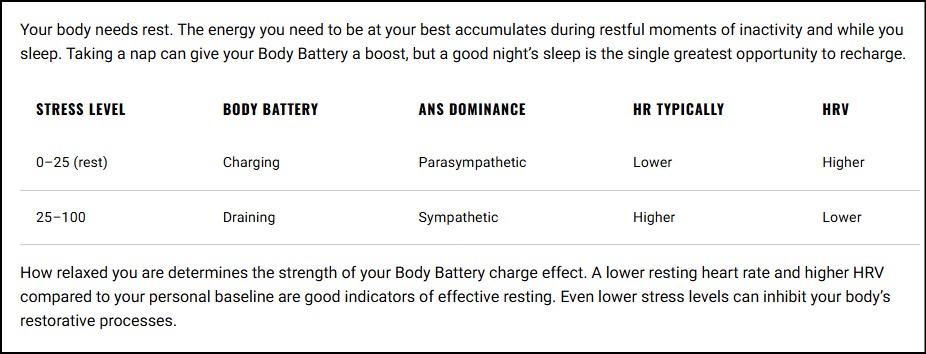
It tells me sleep is powerful for restoring the body. This, well, this does make sense. I will continue to keep an eye on my 7 day chart to see what appears to be having the most impact.

